What Is IVF? A Brief Introduction
In Vitro Fertilisation — commonly known as IVF — is one of the most remarkable achievements in modern reproductive medicine. The term "in vitro" is Latin for "in glass," referring to the fact that fertilisation takes place outside the human body, in a specially controlled laboratory environment rather than inside the fallopian tube.
IVF was first successfully performed in 1978, when Louise Brown was born in England — making history as the world's first "test-tube baby." Since then, more than 8 million babies have been born worldwide through IVF, and the procedure has become a well-established, safe, and effective treatment for many forms of infertility.
At Geeta IVF Centre, we believe that knowledge is the first step toward empowerment. Whether you are just beginning to explore fertility treatment or are preparing for your first IVF cycle, this guide will walk you through everything you need to know — in clear, compassionate language.
Who Is a Candidate for IVF?
IVF is recommended for a wide range of conditions that make natural conception difficult or impossible. Your fertility specialist will conduct a thorough evaluation before recommending IVF, but the following are the most common indications:
- Blocked or damaged fallopian tubes: The fallopian tubes carry eggs from the ovaries to the uterus. If they are blocked — due to prior infection, endometriosis, or previous surgery — eggs cannot meet sperm naturally. IVF bypasses this barrier entirely.
- Unexplained infertility: In roughly 10–15% of infertile couples, no specific cause can be identified despite thorough testing. IVF often succeeds where other treatments have not.
- Advanced maternal age: Egg quality declines significantly after age 35. IVF allows doctors to select the best quality embryos for transfer, improving the odds of success.
- Male factor infertility: Low sperm count, poor motility, or abnormal morphology can prevent fertilisation. IVF, especially when combined with ICSI (Intracytoplasmic Sperm Injection), can overcome many male infertility factors.
- Polycystic Ovary Syndrome (PCOS): Women with PCOS who do not respond to medications like Clomiphene may benefit from IVF with careful ovarian stimulation protocols.
- Endometriosis: Tissue similar to the uterine lining grows outside the uterus, affecting egg quality and the uterine environment. IVF can help achieve pregnancy despite moderate to severe endometriosis.
- Genetic disorders: Couples carrying known genetic conditions can use IVF with Preimplantation Genetic Testing (PGT) to screen embryos before transfer.
- Fertility preservation: Women facing cancer treatment or other health conditions may freeze eggs or embryos through IVF for future use.
The IVF Process: Step by Step
IVF is not a single procedure but a series of carefully coordinated steps spread over approximately 4 to 6 weeks. Here is a detailed breakdown of each phase:
- Step 1: Initial Consultation & Baseline Testing Your journey begins with a thorough consultation. Your doctor will review your medical history, previous treatments, and conduct baseline investigations. For women, this includes blood tests to measure hormone levels (FSH, LH, AMH, estradiol), a transvaginal ultrasound to assess ovarian reserve and antral follicle count, and a uterine evaluation. For men, a semen analysis is performed to assess sperm count, motility, and morphology. These results help personalise your treatment protocol.
- Step 2: Ovarian Stimulation (Superovulation) Normally, the ovaries produce one egg per month. To maximise success, IVF uses hormone injections (typically recombinant FSH or gonadotropins) to stimulate the ovaries to produce multiple eggs simultaneously. This phase typically lasts 8 to 14 days. During this time, you will attend regular monitoring appointments — transvaginal ultrasounds and blood estradiol tests — so your doctor can track follicle growth and adjust medication doses precisely. A "trigger shot" (usually hCG or a GnRH agonist) is administered 34–36 hours before egg retrieval to complete egg maturation.
- Step 3: Egg Retrieval (Oocyte Pick-Up) Egg retrieval is a minor surgical procedure performed under light sedation so you are comfortable and relaxed throughout. Using transvaginal ultrasound guidance, your doctor inserts a fine needle through the vaginal wall into each follicle and gently aspirates the follicular fluid containing the eggs. The entire procedure typically takes 20 to 30 minutes. Most women feel mild cramping afterward and can return home within a few hours. The retrieved eggs are immediately handed to the embryologist in the laboratory.
- Step 4: Sperm Collection & Preparation On the day of egg retrieval, a fresh semen sample is collected from the male partner. The sample undergoes a "sperm wash" — a laboratory process that separates healthy, motile sperm from seminal fluid, dead cells, and debris, concentrating the best sperm for fertilisation. If the male partner has a very low sperm count or no sperm in the ejaculate, surgical sperm retrieval techniques (TESA/PESA) can be used to collect sperm directly from the testes or epididymis.
- Step 5: Fertilisation in the Laboratory The embryologist places the prepared sperm with the mature eggs in a petri dish in a precisely controlled incubator. In conventional IVF, sperm and eggs are incubated together, and fertilisation occurs naturally. If sperm quality is poor, ICSI (Intracytoplasmic Sperm Injection) is used instead — a single healthy sperm is injected directly into each mature egg using a microscopic needle. Fertilisation is confirmed the following day by checking for two pronuclei (one from each parent) inside the egg.
- Step 6: Embryo Development & Grading Over the next 3 to 5 days, fertilised eggs develop into embryos inside the incubator. Embryologists observe and grade the embryos at multiple stages — Day 2 (4-cell), Day 3 (8-cell), and Day 5 (blastocyst). Grading assesses cell number, symmetry, and fragmentation. Blastocyst culture (to Day 5 or 6) is preferred when possible, as blastocysts have a higher implantation potential and allow better selection of the most viable embryos.
- Step 7: Embryo Transfer Embryo transfer is a simple, painless procedure — similar to a cervical smear — performed without anaesthesia. Using a soft, thin catheter guided by ultrasound, the doctor carefully places one or two selected embryos into the uterine cavity. The number of embryos transferred depends on your age, embryo quality, and previous treatment history. To reduce the risk of multiple pregnancies, single embryo transfer (SET) is increasingly recommended, especially for younger patients with good-quality blastocysts. Any remaining good-quality embryos can be frozen (vitrified) for future use.
- Step 8: The Two-Week Wait & Luteal Support After the embryo transfer, progesterone support (via vaginal pessaries, injections, or gel) is prescribed to prepare the uterine lining for implantation and support early pregnancy. The next 10 to 14 days — often called the "two-week wait" — can be emotionally challenging. It is important to rest adequately, avoid strenuous exercise, stay hydrated, and lean on your support network. Avoid smoking, alcohol, and excessive caffeine during this period.
- Step 9: Pregnancy Test Approximately 10 to 14 days after the embryo transfer, a blood test measures the level of beta-hCG (human chorionic gonadotropin) — the pregnancy hormone. A rising hCG level confirms pregnancy. If the result is positive, an ultrasound is scheduled 2–3 weeks later to confirm the gestational sac and fetal heartbeat. If the cycle is unsuccessful, your doctor will review the results and discuss next steps, which may include a frozen embryo transfer (FET) using embryos cryopreserved from the same cycle.
IVF Success Rates: What Affects Your Chances?
IVF success rates vary depending on several factors. Understanding them helps set realistic expectations while maintaining hope.
- Age: This is the single most important factor. Women under 35 have the highest success rates (often 40–50% per cycle with own eggs). Rates decline gradually from 35 onwards and more steeply after 40.
- Ovarian reserve: A good ovarian reserve (measured by AMH level and antral follicle count) means more eggs can be retrieved, giving the embryologist more embryos to work with.
- Embryo quality: High-grade blastocysts have significantly better implantation rates than lower-grade embryos.
- Cause of infertility: Couples with tubal factor infertility typically respond better to IVF than those with severely diminished ovarian reserve.
- Lifestyle factors: Body weight (BMI), smoking, alcohol consumption, and stress all influence IVF outcomes. Maintaining a healthy BMI and avoiding smoking dramatically improves success rates.
- Clinic quality and expertise: The experience of the medical team, laboratory standards, and individualised protocols play a crucial role. Choosing a reputable clinic with transparent success rate data is essential.
Remember: IVF success rates are statistical averages, not individual guarantees. Many couples conceive on their first cycle; others need two or three. Your doctor will give you a personalised estimate based on your specific circumstances.
The Emotional Side of IVF
IVF is not only a physical journey but a deeply emotional one. Hormonal medications can amplify mood swings, and the uncertainty of each stage — from stimulation to the two-week wait — can bring feelings of hope, anxiety, and vulnerability in equal measure.
It is completely normal to feel overwhelmed. Here is what we recommend:
- Talk openly with your partner. IVF affects both of you, and staying connected strengthens your bond and resilience.
- Seek professional counselling. Many IVF clinics, including ours, offer access to fertility counsellors who specialise in the psychological aspects of infertility.
- Connect with support communities. Online forums and local support groups allow you to share experiences with others who truly understand.
- Practice mindfulness and gentle relaxation techniques — yoga, meditation, and guided breathing can help manage anxiety during treatment.
- Set boundaries around how much you discuss your treatment with extended family and friends. Protect your emotional space.
Questions to Ask Your IVF Doctor
Going into your consultation prepared helps you make informed decisions. Consider asking:
- What is my ovarian reserve, and how does it affect my protocol?
- Will you use conventional IVF or ICSI for fertilisation, and why?
- How many embryos do you recommend transferring, and why?
- What is your clinic's live birth rate for patients my age?
- Should I consider Preimplantation Genetic Testing (PGT)?
- What happens to any surplus embryos after transfer?
- What support do you offer if this cycle is unsuccessful?
- Are there any lifestyle changes I should make before starting?
Conclusion: Hope, Courage, and the Right Team
IVF represents one of medicine's greatest gifts to couples and individuals who dream of parenthood. While it is not without challenges — physical, emotional, and financial — it has helped millions of families around the world realise their deepest wish.
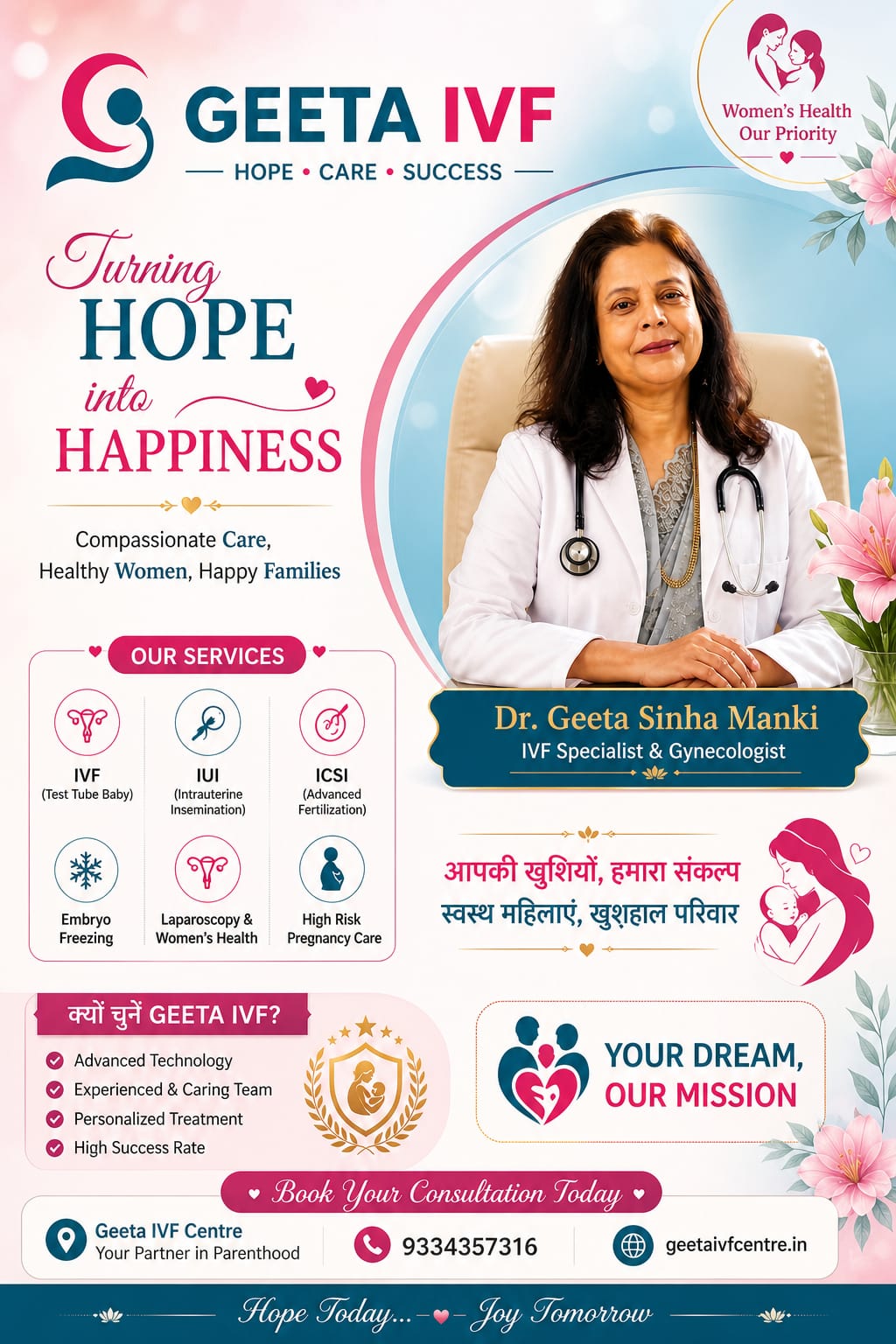
At Geeta IVF Centre, we walk beside you at every step — from your very first consultation through to the joy of a positive pregnancy test and beyond. Dr. Geeta Sinha Manki and our dedicated team bring not only clinical expertise but genuine compassion to every patient's journey.
If you are considering IVF or simply want to understand your fertility better, we warmly invite you to book a consultation with us. Your journey to parenthood begins with a single step.
Ready to Take the Next Step?
Book a personalised consultation with Dr. Geeta Sinha Manki and get a clear, compassionate assessment of your fertility options.
Book Your Consultation